Claude Code vs Cowork vs OpenClaw: Which Surface for Which Job
Anand B · 2026-08-14
These three products end up on the same search results page and are not really competing. One is a coding agent, one is a knowledge-work agent from the same company, and one is a self-hosted personal assistant. Choosing between them by feature count produces nonsense; choosing by what the work is and how closely you intend to watch it produces an obvious answer almost every time.
Facts here were checked against primary sources on 2026-07-26. Two of these products are months old and moving quickly, so verify before making a decision on the strength of any article, this one included.
What each one actually is
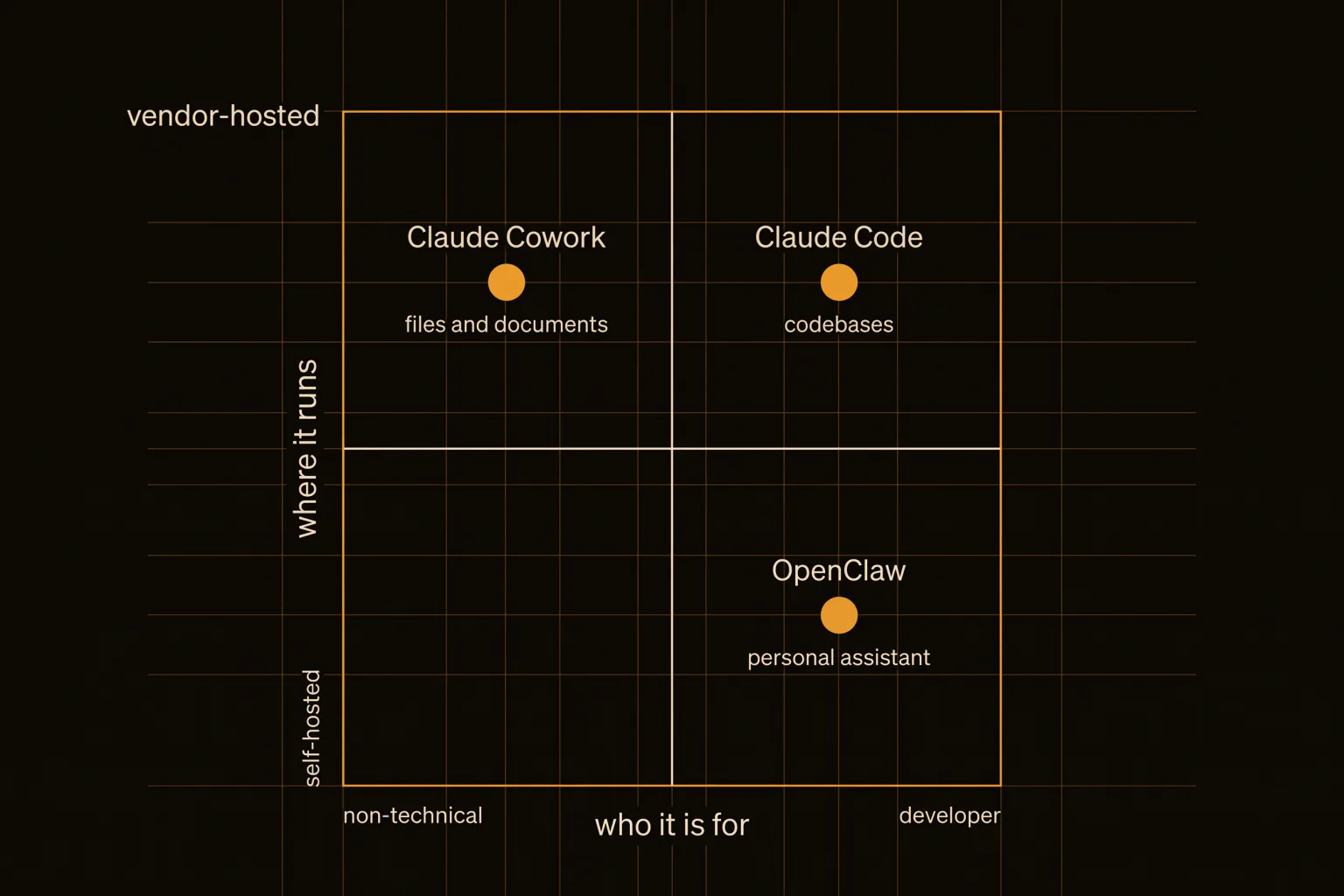
Claude Code is Anthropic's agentic coding tool. It reads a codebase, edits files, runs commands, and ships across five surfaces — terminal, VS Code, JetBrains, a desktop app, and web plus mobile. Its unit of work is a repository.
So what is Cowork? It is also Anthropic's, and it is the one people mistake for a Claude Code alternative. It is a Claude Code-style agent aimed at general knowledge work: it reads, edits and creates files in folders you grant it, and it was built primarily for non-technical users. It launched as a macOS desktop app in January 2026 and reached web and mobile for Max subscribers in July 2026. The canonical tasks are reconciling a spreadsheet, assembling a deck, pulling scattered updates into one report. Its unit of work is a folder of documents.
The framing Anthropic uses is that Chat is a conversation while Cowork is a working session: you describe the task, it plans and executes, and you steer as it goes. Sessions are not tied to one device either — close the laptop and pick the same session up elsewhere.
OpenClaw is not Anthropic's and not a coding tool. It is an open-source, self-hosted personal assistant framework — previously called ClawdBot, renamed after a trademark dispute — that connects a model to your tools and messaging apps. It has a heartbeat polling loop so it can act without being prompted, a skill system with its own distribution hub, and companion apps for macOS, iOS and Android. It passed 360,000 GitHub stars within roughly five months of its first commit. Its unit of work is your life admin.
| Claude Code | Claude Cowork | OpenClaw | |
|---|---|---|---|
| Made by | Anthropic | Anthropic | Open-source community |
| Built for | Developers | Non-technical users | Anyone self-hosting |
| Works on | Repositories | Folders and documents | Tools and messages |
| Runs where | Vendor-hosted, local CLI | Vendor-hosted | Your own hardware |
| Acts unprompted | Via Routines | No | Via heartbeat |
Claude Code vs Cowork: same company, different files
The short answer is that they are not alternatives, they are siblings. Both are agentic working sessions from Anthropic; one is pointed at a repository and one at a folder of documents. Team seats at $20/seat/month include both, which is the clearest possible signal that the intended answer is "use each for what it is for" rather than "pick one".
If you write code, git is your undo button and a test suite is your gate, and Claude Code is built around both. Cowork has neither, because a spreadsheet has no git log. That single difference explains most of the design divergence: an agent working on documents has to be more conservative, because there is no cheap way to revert.
The question that actually decides it
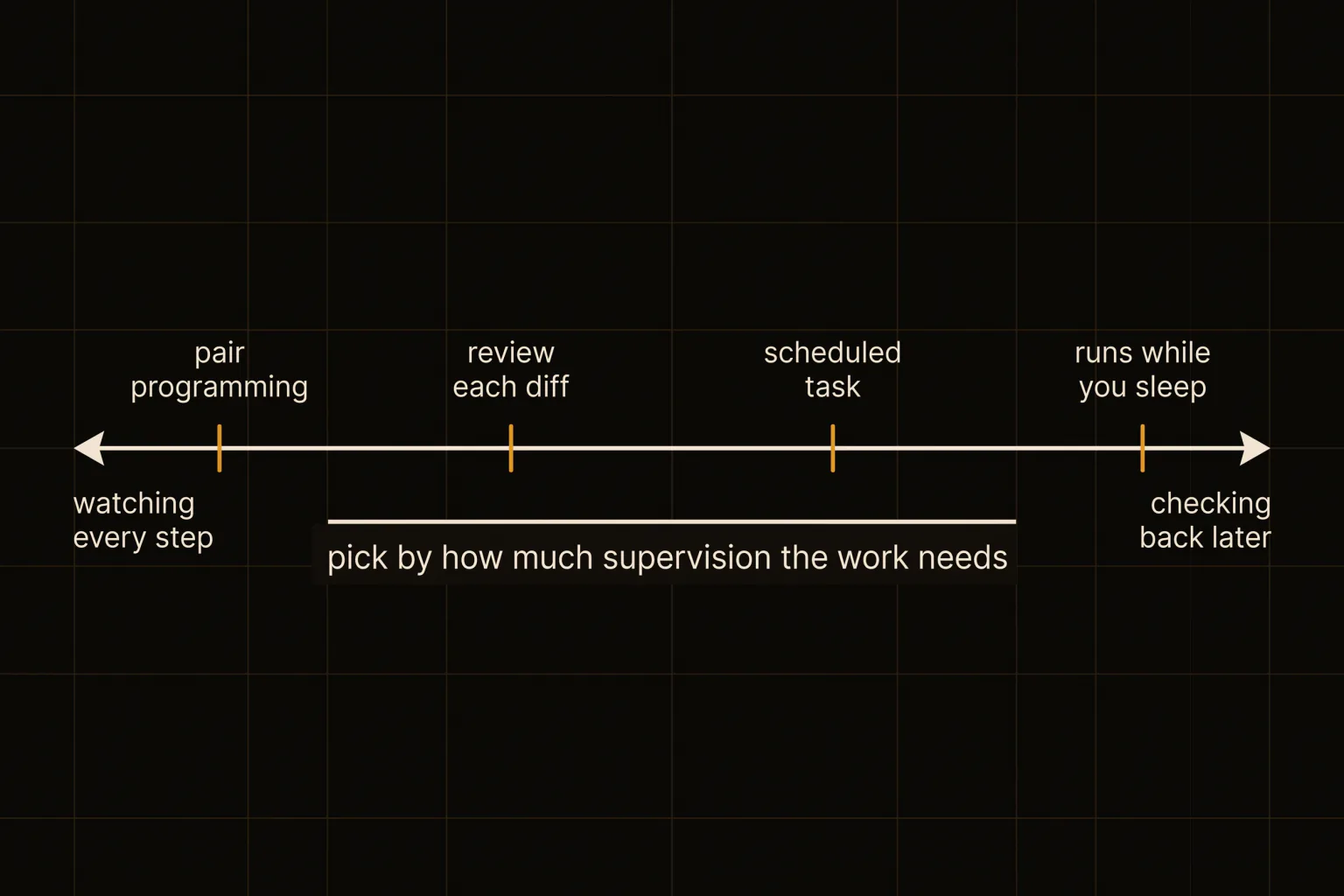
Ask how closely you intend to watch, and the choice mostly makes itself. There are 4 rough positions on that spectrum.
Work you will watch every step of wants an interactive coding surface: an editor extension or a terminal session, where you see each diff as it lands. Nothing else on this list is designed for that.
Work you will review afterwards in a batch wants Claude Code with a real gate — a test suite, a lint run, a pull request. This is the majority of software work and the case Claude Code is built around.
Work nobody will review closely, but which is low-stakes and repetitive, is where Cowork fits, provided the task is documents rather than code. Getting a report wrong is recoverable in a way that getting a migration wrong is not.
Work that runs unprompted on your own hardware, touching your own accounts, is OpenClaw's case. That is also the highest-trust configuration on this list, and it deserves the most thought.
OpenClaw vs Claude Code: an ownership question
These two are the least comparable pair on the list, and the comparison people search for is really about self-hosting rather than about coding.
OpenClaw's design choices tell you what it is for. A heartbeat polling loop means it can wake up and act on its own, which no coding tool wants as a default — you do not want an agent editing your repository because 20 minutes elapsed. Its skill system and distribution hub mirror the plugin ecosystems around coding agents, but pointed at personal automation: email, calendar, browser, filesystem.
The honest summary is that if your question is "which should I use to write software", the answer is Claude Code and OpenClaw is not a contender. If your question is "can I run a capable agent entirely on my own hardware", then OpenClaw is a serious answer and Claude Code's hosted surfaces are not.
Where your data goes
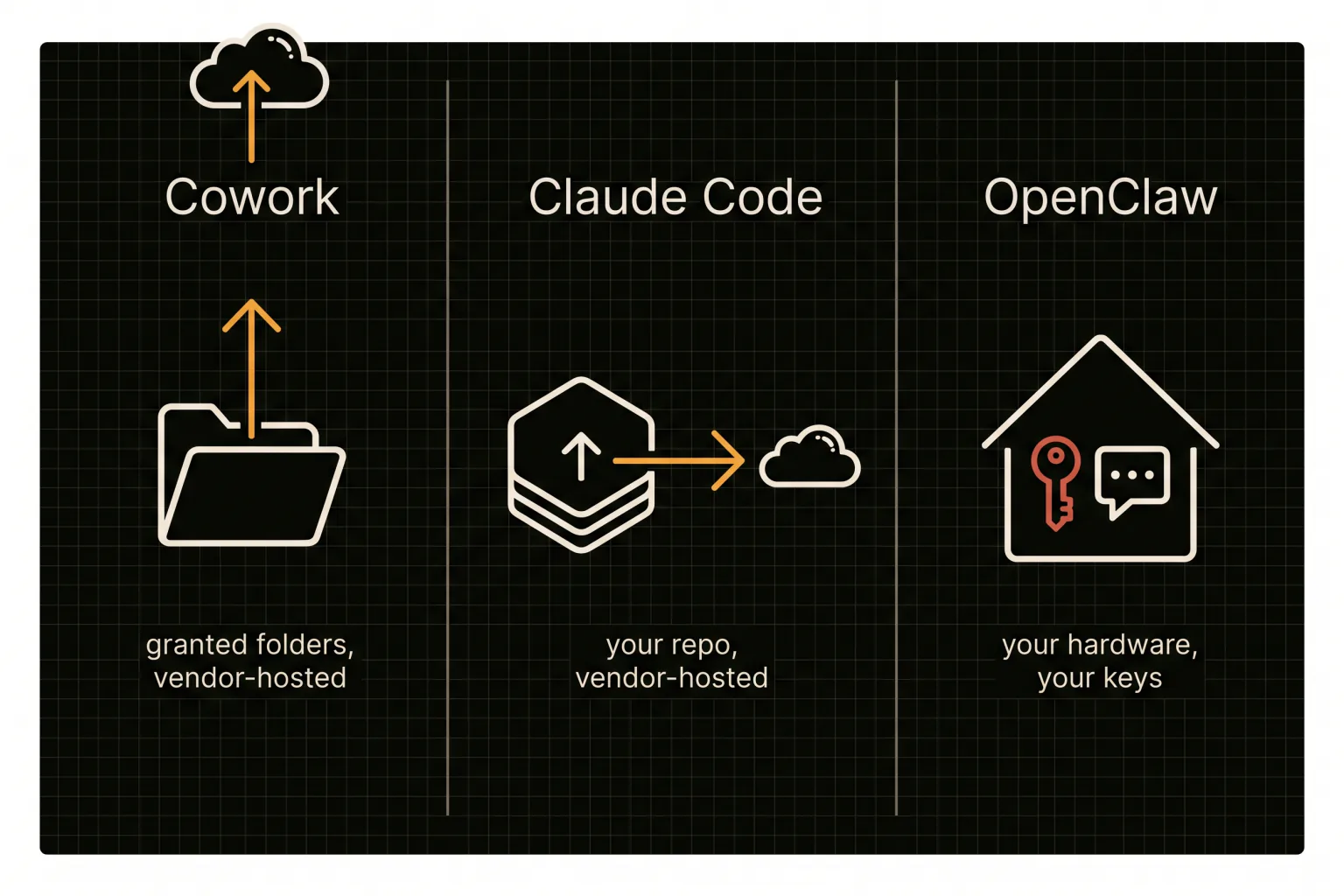
This is the axis people skip, and it is the one with consequences.
The two Anthropic products are vendor-hosted. You are extending trust to a company with a published policy, and the compensating control is scope: Cowork works in folders you grant it, and Claude Code has a permission system and an optional OS-level sandbox. The failure modes are understood and the blast radius is boundable.
Self-hosting inverts the arrangement rather than removing the risk. Nothing leaves your hardware, which is genuinely the right answer when data residency rules it out. In exchange you own patching, key storage, and the consequences of a misconfiguration, and a self-hosted assistant that reads your email and holds your API keys is a high-value target sitting on your own network. An agent with a heartbeat, broad tool access, and your credentials is a serious thing to run — worth the same care you would give any always-on service with your keys in it, which for most people means more care than a GitHub star count implies.
If you are thinking about the trust envelope generally, our piece on permissions and sandboxing covers where the real blast radius sits.
Picking, in one pass
Writing or maintaining code: Claude Code. Nothing else here is aimed at repositories, and the comparison mostly ends there.
Documents, spreadsheets and reports, especially for someone who does not want a terminal: Cowork. It is the same underlying idea pointed at a different kind of file, and Team seats include it alongside Claude Code, which is worth knowing if some of your seats are for non-engineers.
A proactive assistant on hardware you control, with tolerance for running your own infrastructure: OpenClaw.
Several coding agents at once, with worktree isolation, a spatial layout, or non-Anthropic models: this is where third-party orchestrators live, and SpeakCode is ours. Worth being straight that the official desktop app already handles side-by-side sessions and visual diffs, so this case is narrower than it was six months ago — the surface comparison has the honest version.
Different assumptions about who is watching
The reason these products feel like competitors is that they all describe themselves as agents doing work for you. The reason they are not is that each one assumes a different amount of supervision and a different kind of file.
Two of them are made by the same company and are meant to be used together rather than chosen between. The third answers a question about ownership rather than capability. If you find yourself comparing their feature lists column by column, the comparison has already gone wrong; go back to what the work is and how much of it you are willing to not look at.
One last note on staleness, with a number attached. Between 2026-07-18 and 2026-07-26 — 8 days — the official surface list for one of these products changed enough to invalidate an argument we had already planned and researched. We threw out the draft rather than publish the stale version.
Anything you read about this category, including this, is a snapshot with a shelf life measured in weeks. The practical defence is to check the vendor's own docs before acting on any comparison, and to distrust any article that does not tell you when it was verified. This one was verified on 2026-07-26.