Codex vs Claude Code: An Honest 2026 Comparison (We Run Both Daily)
Anand B · 2026-07-18
Forty-two autonomous maintenance loops run against our repo on a schedule. Flaky-test triage, dead-code sweeps, SEO audits: each is a headless claude -p invocation that wakes up, does one narrow job, and ends in a small pull request. That number is the honest place to start any codex vs claude code comparison, because it tells you what the question has become. In 2023 you asked which model wrote better code. In 2026 you ask which CLI you can build a system around.
We build SpeakCode, a macOS canvas app where every terminal card runs its own AI coding agent, so we run Claude Code and Codex side by side daily rather than hypothetically. What follows is what that daily contact taught us, criteria first, verdict last.
The criteria, stated up front
A fair comparison fixes its criteria before the scoring starts. Ours:
- Multi-file agentic work. Can the tool plan and execute a change touching a dozen files without losing the thread?
- Extensibility. Can you teach it your codebase's rules and wire it into your own infrastructure?
- Review quality. How good is it at finding what's wrong with code it didn't write?
- Automation. Does it run headless, on a schedule, with no human at the keyboard?
- Total cost, measured in engineer attention rather than subscription dollars.
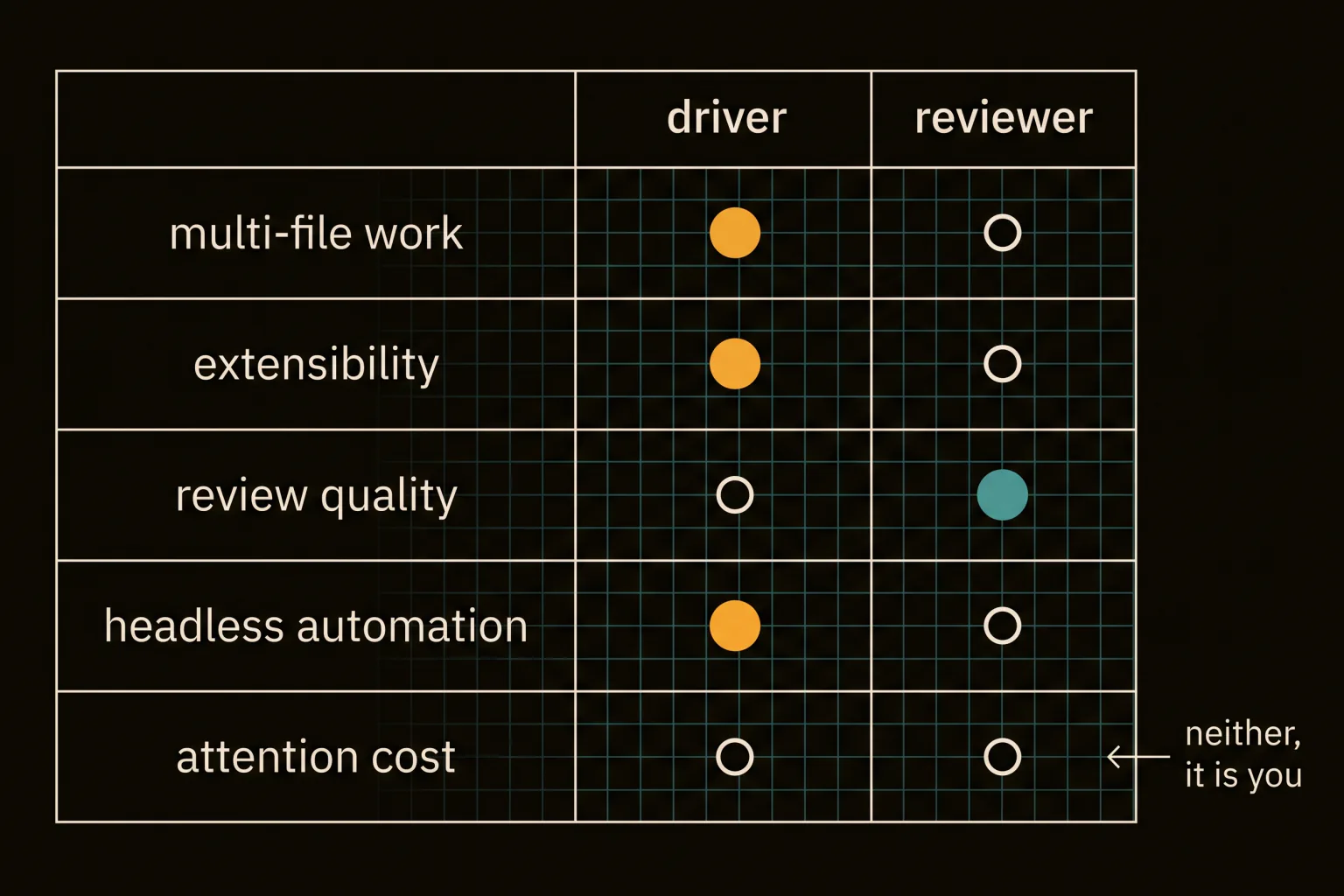
Notice what's absent: raw benchmark scores. Both underlying model families are now strong enough that the CLI around the model decides outcomes more than the model does.
Notice too that criterion 5 does not belong to either tool. Attention is spent by you, and it is the only budget on this list that cannot be topped up, which is why it decides more than the other four combined.
Where Claude Code pulls ahead
The ecosystem. Claude Code has accumulated a set of primitives that compound. CLAUDE.md files give it persistent project memory, so the agent knows your build commands and conventions before the first prompt. Hooks run deterministic scripts on tool events; we use one to block edits to generated files. Skills are reusable SKILL.md playbooks the agent loads on demand; our 42 maintenance loops are each a skill plus a cron entry. Subagents fan work out in parallel with isolated context. MCP servers connect it to anything with an API. Plan mode forces a read-only proposal before any write lands, and Shift+Tab cycles permission modes when you want to slide between cautious and autonomous.
None of these is impressive alone. Together they turn a chat-in-a-terminal into something you can operate.
A worked example: our flaky-test loop wakes every night, scans CI history for tests that failed then passed on retry, bisects the nondeterminism, and opens a PR with either a fix or a quarantine annotation. Nobody attends it. Building that on Claude Code took an afternoon, because headless mode, skills, and CLAUDE.md already existed as load-bearing parts. We could not see a comparable path with Codex's current tooling, and we looked.
If you're starting from zero, the getting-started tutorial covers those primitives in about an hour.
The steelman for Codex
Here is the case for the tool we're about to rank second, made honestly.
Codex, OpenAI's codex CLI, is a genuinely good coding agent, and as a reviewer it is frequently better than Claude Code. codex review reads a diff with no investment in the code and no memory of the reasoning that produced it, and that ignorance is an asset. It catches logic errors a driver-agent rationalizes past: inverted conditionals, off-by-one boundary handling, a cache key missing one dimension of variance. Its sandboxed execution model is also conservative by default, which some security teams prefer as a baseline posture.
If your work is mostly single-file edits and tight scripts, and you already live on a ChatGPT plan, Codex alone is a defensible choice. It's fast, competent, and its review instincts are sharp. What separates the two tools has little to do with code quality and everything to do with the surface area available for building systems around them.
The pattern we actually run
Claude Code writes the change. Then, before merge, we run codex review on the diff and let Codex attack it as an adversarial second opinion.
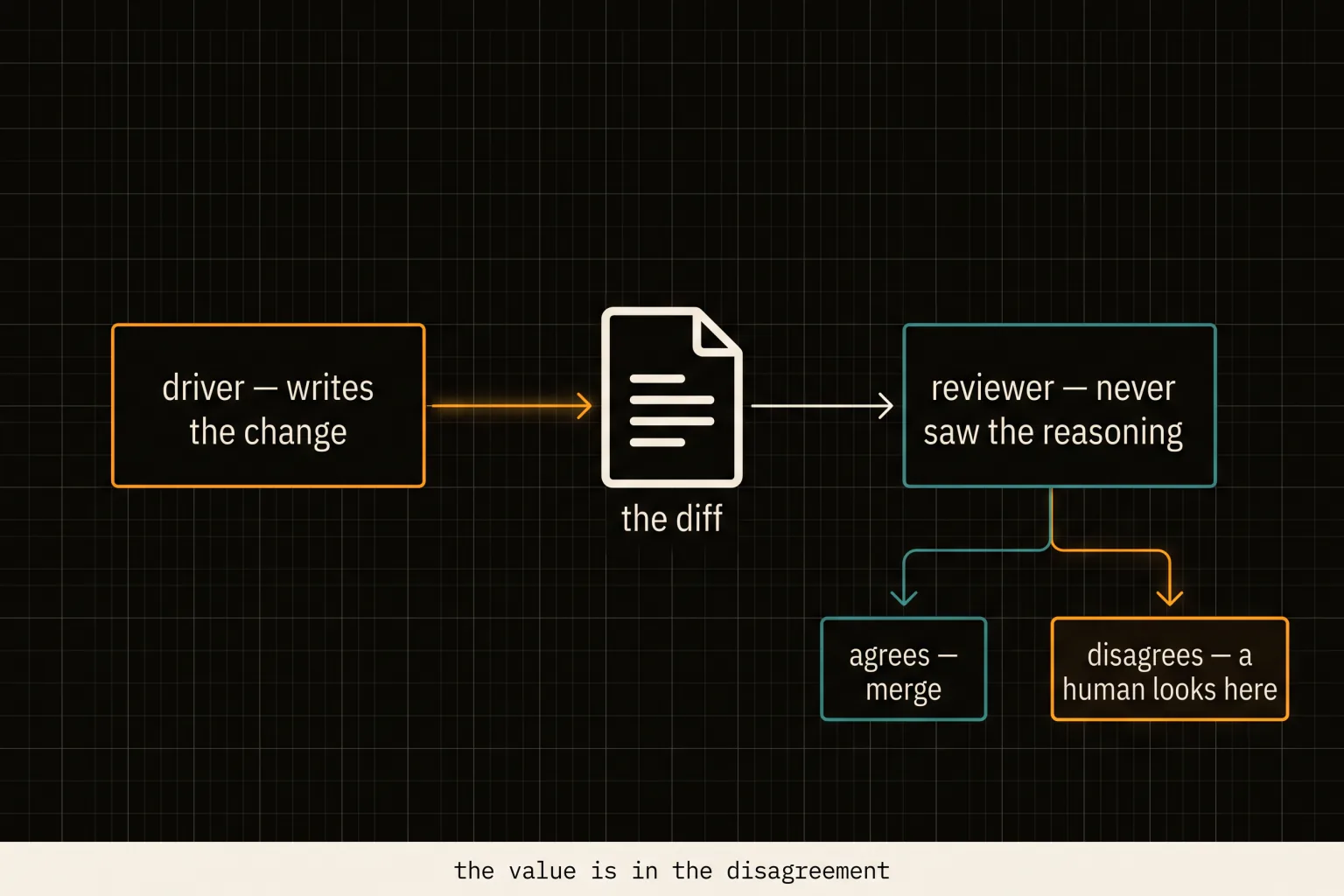
The information isn't in either verdict alone. It's in the disagreement. When Codex flags something Claude Code was confident about, that's precisely where a human should look — different training runs produce different blind spots, and a flag from the second model marks the spot where they don't overlap. When both models agree the diff is sound, we merge with meaningfully more confidence than either opinion could supply by itself.
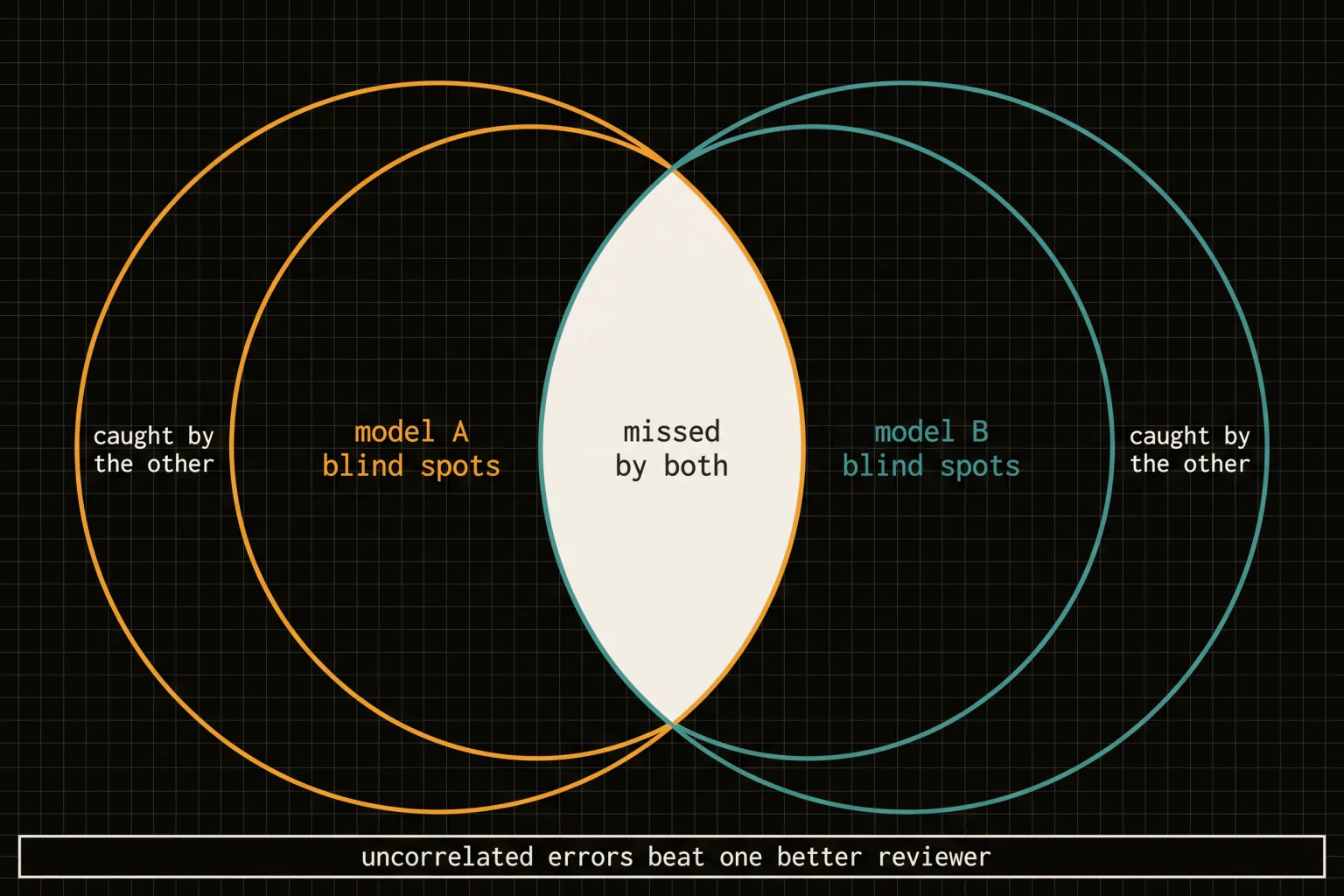
One sentence of theory: two imperfect reviewers with uncorrelated errors beat one better reviewer whose errors correlate with the author's.
The corollary is the part worth internalising, because it sets your expectations honestly. A second model does not shrink the set of bugs that reach production to zero — it shrinks it to the overlap, the failures both models share. Those exist, and they are the ones that need tests and staged rollouts rather than more reviewers. Adding a third model has sharply diminishing returns for the same reason: each additional reviewer only pays for the part of its blind spot that does not already overlap.
There is a practical detail that makes this cheap to run: the reviewer should see the diff and nothing else. No transcript, no plan, no explanation of why the change looks like that. Handing over the reasoning is how you correlate the errors you were paying to keep independent.
People searching for a claude code alternative are usually asking the wrong question. You don't switch to Codex; you add it. And the logic runs in reverse for Codex-first teams, who should be adding Claude Code as the reviewer they don't have.
Cost, measured correctly
Both are subscription-attached CLIs: Claude Code rides on Claude Pro or Max, Codex on ChatGPT plans. The dollar difference between them is noise for a professional team.
The cost that dominates is engineer time babysitting a serial agent. One engineer watching one agent finish one task is barely better than typing it themselves. One engineer running parallel Claude Code sessions on feature work while scheduled loops handle maintenance and Codex gates every merge is a different operating model entirely, and both subscription line items disappear into it. We wrote up how that shift changes daily practice in our post on workflows that actually ship.
Two caveats on the dollars, since "it's noise" deserves qualification. Consumption scales with how many agents you run rather than with which tool you picked, so the number that moves your bill is concurrency — we broke that down separately in what running agents in parallel actually costs. And a review pass is much cheaper than a driving session, because reading one diff costs a fraction of exploring a codebase, so adding a second model as a reviewer is close to the cheapest capability you can bolt on. It is the ordering that matters: 2 drivers is expensive, 1 driver plus 1 reviewer is not.
The verdict
Claude Code as the driver. Codex as the adversarial reviewer. Run both.
Claude Code takes the driver seat on criteria one, two, and four: the CLAUDE.md, hooks, skills, subagents, and MCP stack is currently the deepest way to encode your team's judgment into an ai coding agent, and headless mode makes automation real rather than aspirational. Codex wins criterion three often enough that skipping it costs you real bugs; fresh eyes on every diff, at the price of one command, is the cheapest review capacity you will ever buy.
So the claude code vs codex framing carries a false premise. The teams pulling ahead in 2026 aren't the ones that picked the right single CLI. They're the ones orchestrating several — agents writing, agents reviewing, agents disagreeing — and spending human attention exactly where the models diverge.
Start tomorrow: keep whichever driver you have, add the other model as a mandatory review pass on your next 10 PRs, and count how many of its objections make you change the diff. That number is your answer, grounded in your codebase instead of ours.
Interpret it honestly when you have it. If 3 or more of 10 objections changed a diff, the second pass has already paid for itself and should become mandatory. If the count is 0, you have learned something genuinely useful — either your changes are small enough that a second reviewer adds nothing, or your first-pass discipline is better than most, and either way you can stop. What you should not do is run the experiment, get a positive result, and then leave the review pass as an optional step people skip when they are in a hurry.